THGBMBG7D2KBAIL 16GB eMMC 5 for Legacy Embedded Storage
THGBMBG7D2KBAIL 16GB eMMC 5 for Legacy Embedded Storage
THGBMBG7D2KBAIL is a Toshiba managed NAND device that integrates 16GB of flash memory and an eMMC controller in a compact 153-ball FBGA package. Its e‑MMC 5.0 interface and HS400 capability made it suitable for embedded systems that needed soldered storage with lower host-management overhead. For today’s OEM and EMS buyers, the primary value is exact-part continuity for existing designs, supported by disciplined lifecycle and source verification.
Quick Answer
Use THGBMBG7D2KBAIL when the released BOM requires 16GB e‑MMC 5.0 storage in a 153-ball FBGA package measuring 11.5 × 13 × 0.8mm. Toshiba published sequential HS400 read performance of up to 270MB/s and an operating-temperature range of −25°C to +85°C; confirm current lifecycle and actual lot condition before purchase.
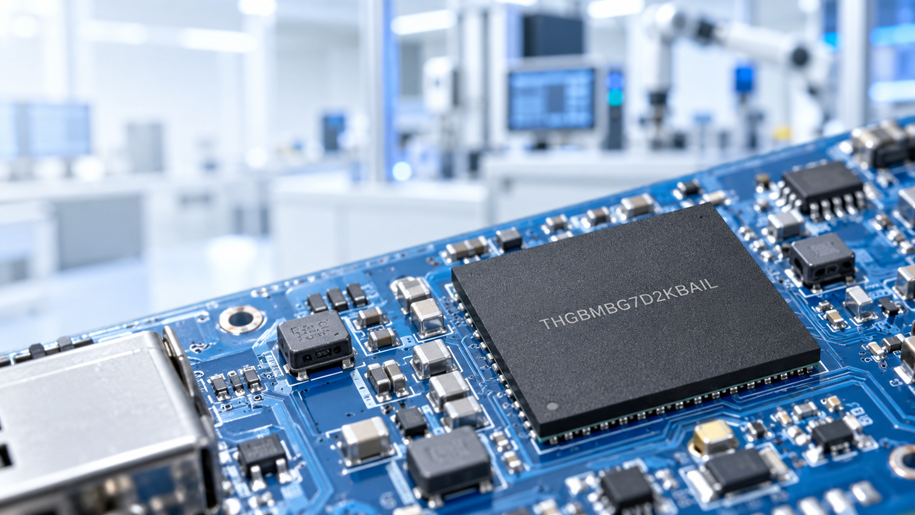
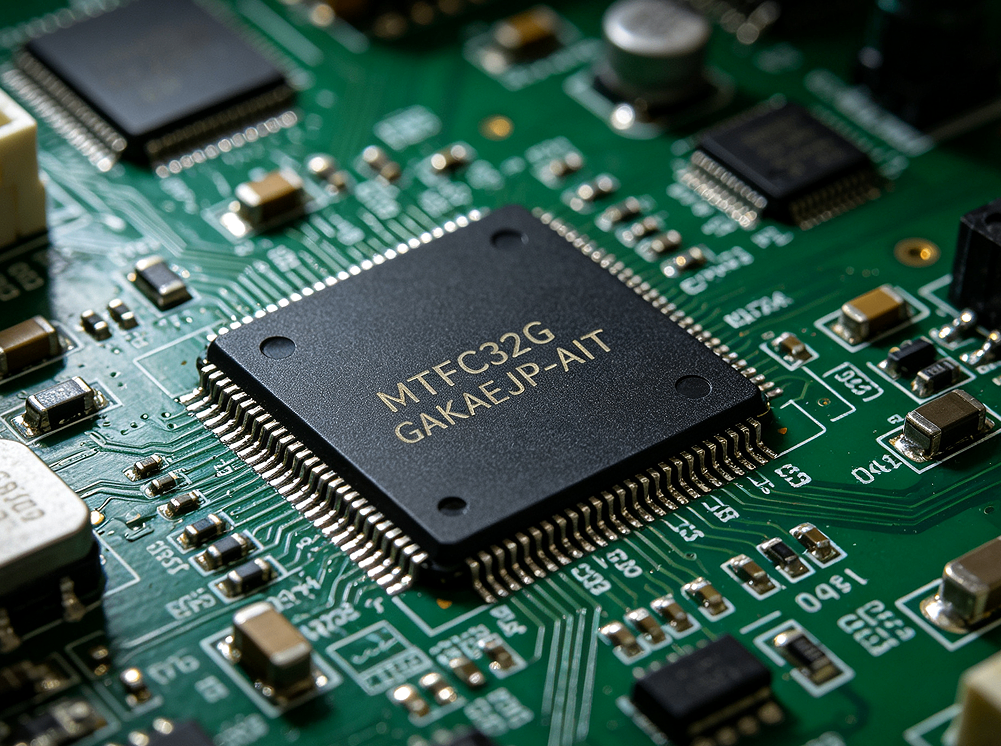
Concept illustration—not an actual Toshiba or KIOXIA product photograph or package drawing.
Product Overview and Positioning
THGBMBG7D2KBAIL combines NAND flash and a controller behind the JEDEC e‑MMC 5.0 interface. The controller manages internal NAND operations, allowing the host to use standardized command and data modes instead of implementing raw-NAND management directly. It is a board-level storage component, not a removable card or complete SSD.
The device was announced in 2013 as a 16GB product using Toshiba’s second-generation 19nm NAND process. That age makes it more appropriate for repair, service inventory and approved legacy production than for unrestricted new design. A newer 16GB eMMC cannot be treated as a drop-in replacement solely because its capacity matches.
Four Advantages for Approved Legacy Designs
1 Managed eMMC Architecture
The integrated controller reduces the host’s direct NAND-management burden. Compatibility still depends on the processor, boot ROM, operating system, eMMC feature set and qualified initialization sequence.
2 HS400 Performance Support
Toshiba published sequential read performance of up to 270MB/s in HS400 mode. This is a manufacturer test figure, not a guaranteed application benchmark; delivered speed depends on the host controller, software, workload and board design.
3 Compact 16GB Storage
The 16GB capacity is integrated into one 153-ball package measuring 11.5 × 13mm with a maximum thickness of 0.8mm. The package supports compact embedded boards, but the exact footprint and ball map must remain under engineering control.
4 Standardized Interface Modes
The e‑MMC 5.0 interface supports 1-bit, 4-bit and 8-bit data operation. Buyers should preserve the exact approved part because interface version alone does not prove identical boot behavior, performance or power-loss response.
Technical Parameters and Buying Interpretation
|
Parameter |
Published value |
Procurement meaning |
|
Manufacturer |
Toshiba, now KIOXIA |
Check historical branding and exact top marking. |
|
Capacity |
16GB |
Managed storage capacity; confirm usable host-visible capacity. |
|
Interface |
JEDEC e‑MMC 5.0 |
Requires compatible host and qualified firmware. |
|
Performance |
Up to 270MB/s sequential read |
HS400 manufacturer test figure; system results vary. |
|
Package |
153-ball FBGA |
Confirm footprint, ball map and reflow profile. |
|
Dimensions |
11.5 × 13 × 0.8mm max |
Verify height and PCB mechanical clearance. |
|
Temperature |
−25°C to +85°C |
Do not infer automotive or industrial qualification. |
|
Introduction |
Mass production from Nov. 2013 |
Treat as a mature part and verify lifecycle. |
Use these values for identification and RFQ screening. Final technical release should rely on the controlled manufacturer documentation and the exact suffix, not a marketplace description.
Suitable Application Scenarios
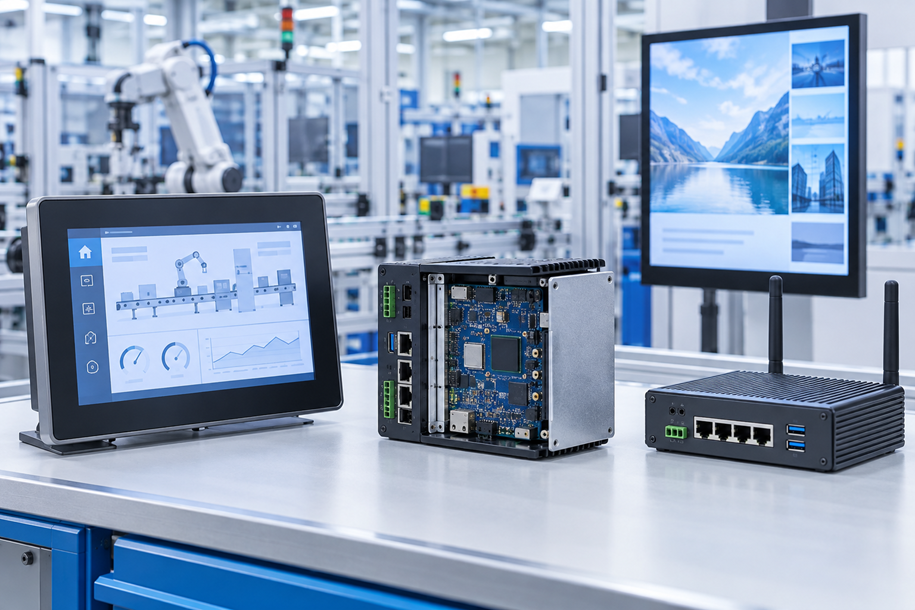
Embedded HMI, signage and gateway application concept.
Industrial HMIs and Embedded Controllers
Established control panels and compact controllers may use the device for boot images, operating systems, configuration files and logs. Validate write workload, thermal conditions, recovery procedures and power-loss behavior.
Digital Signage and Kiosk Systems
Legacy signage players and kiosks can use soldered eMMC for application software and media. Confirm actual read and write requirements rather than selecting by headline capacity or interface version alone.
Network Gateways and Service Repair
Communication terminals and repair programs benefit when an exact approved storage device avoids firmware or boot changes. Long-term planning should include remaining demand, inspection scope and redesign timing.
Buyer Pain Points and Practical Responses
|
Pain point |
Practical response |
|
A newer 16GB eMMC is offered |
Compare interface modes, package, ball map, timing, boot behavior and firmware. |
|
Current lifecycle is unclear |
Request manufacturer or franchised-channel evidence and a dated quotation. |
|
Old stock has uncertain condition |
Confirm date and lot codes, dry-pack status, MSL handling, bake history and solderability plan. |
|
Performance is overstated |
Treat 270MB/s as an HS400 test figure, not guaranteed system throughput. |
|
Traceability is incomplete |
Require supplier qualification, label photos, lot documents and risk-based inspection. |
Lifecycle and Quality Control

Incoming inspection and traceability concept for mature eMMC sourcing.
The part entered mass production in late 2013, so lifecycle confirmation is essential before committing it to a current production plan. Public component databases may describe it as discontinued, but buyers should obtain current evidence rather than treating a secondary database as a manufacturer end-of-life notice.
A suitable incoming-control plan may include document and label review, external visual inspection, X-ray sampling, moisture-barrier and humidity-indicator checks, solderability planning and application-specific electrical testing. The required depth should follow supplier risk, lot history, quantity and end-use criticality.
Frequently Asked Questions
What capacity does THGBMBG7D2KBAIL provide?
It is a 16GB managed NAND eMMC device.
Which interface version does it use?
Toshiba announced it as compliant with the JEDEC e‑MMC 5.0 standard.
Is the published speed 270MB/s?
Toshiba reported sequential read performance up to 270MB/s in HS400 mode. Actual system performance varies.
Can any 16GB eMMC replace it?
No. Compare package, ball map, voltage, interface features, timing, boot behavior and firmware before approval.
Is it automotive qualified?
Do not infer automotive qualification from the operating-temperature range. Request the required qualification documents for the intended application.
What should an RFQ include?
Provide the full MPN, quantity, delivery date, destination, acceptable date codes, packaging, traceability and inspection requirements, plus whether alternatives may be proposed.
Request a Project Specific Quote
THGBMBG7D2KBAIL is best evaluated when an existing approved platform requires 16GB e‑MMC 5.0 storage in its original 153-ball footprint. Send our sales team the target quantity, required date, application, acceptable date codes and inspection criteria. Ask for exact-part confirmation, lot information, packaging condition, traceability and current delivery terms before ordering.
Technical Sources
Toshiba global news release announcing THGBMBG7D2KBAIL. View source
KIOXIA corporate note on the Toshiba Memory name change. View source